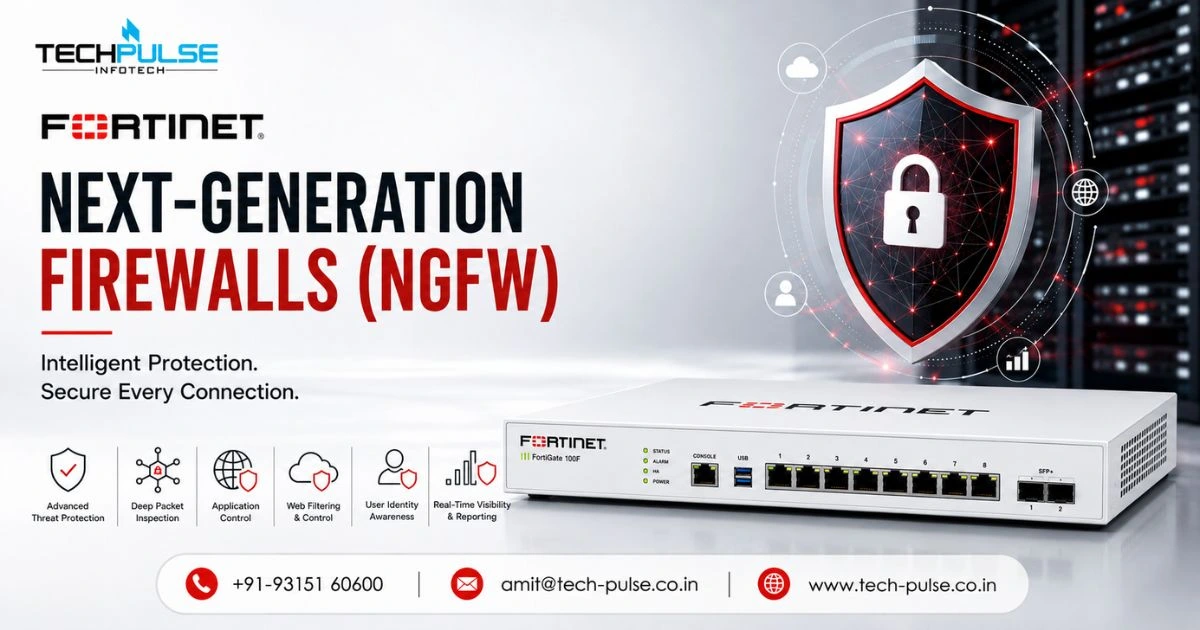
Author: Techpulse Team
Reviewed by: Amit Thakur (12+ Years Experience)
As businesses increasingly depend on cloud applications, remote access, digital communication, and connected devices, network security has become a critical part of daily operations. However, traditional security measures may struggle to identify sophisticated threats hidden within modern network traffic. Cybercriminals continue to develop new techniques to exploit vulnerabilities, steal sensitive information, and disrupt business operations. Therefore, organisations need advanced security solutions that can provide deeper visibility and more effective control over their networks.
This is where Next-Generation Firewalls play an important role. Unlike traditional firewalls that primarily filter network traffic using rules such as IP addresses, ports, and protocols, next-generation firewalls combine these capabilities with advanced inspection and security features. Depending on the platform, they may include application awareness, intrusion prevention, threat intelligence, and additional tools that help organisations identify and manage suspicious activity.
For businesses looking to strengthen their IT infrastructure, choosing the right firewall solution can improve network visibility, support security policies, and help reduce exposure to cyber threats. Techpulse helps businesses explore IT infrastructure and cybersecurity solutions designed to meet their operational requirements. Understanding how next-generation firewalls work is an important first step towards building a more resilient network security strategy.
What Are Next-Generation Firewalls? Discover the Next Level of Network Security
A next-generation firewall (NGFW) is a network security solution that combines traditional firewall functionality with additional capabilities designed to identify and control more complex network activity. It can inspect traffic beyond basic connection information and, depending on its features, recognise applications, detect suspicious patterns, and enforce more detailed security policies.
Traditional firewalls remain useful for controlling traffic between networks. However, modern applications often use encrypted connections, shared ports, and complex communication methods. Consequently, security teams may need additional inspection capabilities to understand what is travelling across their networks. Next-generation firewalls help address this challenge by combining several security functions within a unified platform.
For businesses, this approach can make security management more effective by bringing multiple controls together. Instead of relying exclusively on basic traffic filtering, organisations can develop policies based on applications, users, threat indicators, and other available security information. The exact capabilities depend on the firewall model, licensing, configuration, and supporting services.
Why Traditional Firewalls May Not Be Enough for Modern Businesses
Traditional firewalls provide an essential security layer by allowing or blocking traffic according to predefined rules. For example, administrators can restrict access to particular network ports, control connections between internal and external networks, and prevent unauthorised communication. These functions remain important for protecting business systems.
Nevertheless, modern cyber threats can exploit trusted applications, compromised accounts, and legitimate communication channels. A connection may use an approved port while still carrying malicious activity. Therefore, basic port and IP-based filtering alone may not provide sufficient visibility into every threat scenario.
Next-generation firewalls add capabilities such as application identification, intrusion prevention, and deeper traffic inspection to address these challenges. As a result, businesses can develop more detailed security policies and investigate suspicious activity more effectively. However, an NGFW should form part of a broader cybersecurity strategy rather than serve as the organisation’s only line of defence.
Essential Features That Make Next-Generation Firewalls Powerful
One of the most valuable characteristics of Next-Generation Firewalls is their ability to combine multiple security functions. Although the available features differ between vendors, several capabilities commonly distinguish NGFW platforms from traditional firewall solutions.
Key features may include:
- Deep packet inspection: Examines network traffic beyond basic connection details to identify relevant content or suspicious patterns, subject to the inspection method and encryption.
- Application awareness and control: Identifies supported applications and enables administrators to apply policies to particular application categories or services.
- Intrusion prevention system (IPS): Detects and blocks traffic matching known attack signatures or suspicious behaviour covered by its detection rules.
- User-aware policies: Integrates with supported identity systems to apply network access rules based on user or group information.
- Threat intelligence integration: Uses information about known malicious destinations, indicators, and emerging threats to support detection and prevention.
- URL and web filtering: Restricts access to websites according to configured categories, reputation, or organisational policies.
- Centralised monitoring and reporting: Helps security teams review traffic, policy events, and detected threats through available management tools.
In addition, some NGFW platforms offer encrypted traffic inspection, sandbox integration, and advanced malware detection through optional services or subscriptions. Organisations should check these capabilities carefully because not every firewall includes the same functions by default.
By understanding these features, businesses can select a solution that aligns with their security requirements instead of paying for capabilities they may not need.
How Next-Generation Firewalls Detect and Prevent Cyber Threats
Next-generation firewalls analyse network connections against configured policies and available security intelligence. When traffic reaches the firewall, the system evaluates relevant information, such as the source and destination, application, connection state, and detected threat indicators. It then applies the appropriate rules to allow, restrict, or block the traffic.
Depending on the platform, the firewall may also inspect traffic for attack patterns associated with known exploits, malware communication, or unauthorised application activity. For example, an intrusion prevention system may block a connection that matches a recognised attack signature. Similarly, an application control policy may restrict access to an unapproved service even when that service uses a commonly permitted port.
However, no firewall can identify every possible attack. Unknown vulnerabilities, poorly configured policies, compromised credentials, and certain encrypted threats may require additional controls. Consequently, organisations should combine firewall protection with endpoint security, identity management, regular updates, employee awareness, and continuous monitoring.
Protect Business Applications, Cloud Environments, and Remote Users
Modern organisations rarely operate from a single office or rely on one internal network. Employees may work remotely, access cloud-hosted applications, connect through branch offices, or use business systems from different locations. This distributed environment increases the importance of consistent access controls and network visibility.
Next-generation firewalls can help protect connections between business networks, the internet, data centres, and supported cloud environments. Administrators can create policies that restrict access to sensitive resources, control application usage, and inspect traffic at designated network boundaries. Some solutions also support virtual or cloud-delivered firewall deployments.
Remote access requires particular attention. A firewall can help secure VPN connections and restrict which internal resources remote users may reach. Nevertheless, organisations should also implement multifactor authentication, endpoint compliance checks, and appropriate identity controls. For cloud applications accessed directly by users, a network firewall may not see every connection, so cloud security controls and secure access technologies may also be necessary.
The Business Benefits of Next-Generation Firewalls
Investing in the right network security solution can support business continuity, improve visibility, and strengthen the management of IT risks. Next-generation firewalls can help organisations consolidate selected security functions and establish more detailed controls over network communication.
One major benefit is improved application visibility. By identifying supported applications and applying suitable policies, administrators can better understand how employees and systems use network resources. This visibility can help organisations restrict unnecessary services, enforce acceptable-use policies, and investigate unusual activity.
Another advantage is centralised policy enforcement. Depending on the platform, administrators may manage multiple security functions through a common interface. This can simplify routine administration and help teams maintain consistent rules across supported environments.
Furthermore, improved threat detection can help reduce exposure to certain attacks when the firewall is properly configured and maintained. However, the actual benefits depend on the quality of implementation, available security services, network design, and the expertise of the security team. Businesses should evaluate outcomes against their specific security objectives rather than assume that purchasing a firewall automatically guarantees protection.
Next-Generation Firewalls vs Traditional Firewalls: Understanding the Difference
Although traditional firewalls and next-generation firewalls share the goal of controlling network traffic, they differ in the depth of inspection and the range of security functions they can provide.
A traditional firewall generally focuses on network addresses, ports, protocols, and connection states. These controls are effective for establishing network boundaries and restricting unauthorised connections. However, they may offer limited visibility into application-level activity unless additional capabilities are available.
An NGFW extends these controls through features such as application identification, integrated intrusion prevention, and advanced traffic analysis. This enables more detailed security policies and broader detection capabilities within supported environments.
For example, a traditional firewall might allow or block traffic according to a port and destination, while an NGFW may identify the application using that connection and apply an application-specific policy. The precise difference depends on the products being compared, since some traditional firewall platforms also offer advanced features.
Ultimately, businesses should compare actual capabilities, performance, licensing, management requirements, and integration options rather than rely solely on product labels.
How to Choose the Right Next-Generation Firewall for Your Organisation
Selecting the right firewall requires a clear understanding of the organisation’s network architecture, security risks, and operational requirements. A solution designed for a small office may not provide the performance or management capabilities needed by a large enterprise. Therefore, businesses should assess their current environment before making a purchasing decision.
Consider the following factors when evaluating Next-Generation Firewalls:
- Network throughput: Check performance under the security services you intend to enable, not only headline firewall throughput.
- Concurrent connections: Ensure the platform can support expected connection volumes and peak workloads
- Threat prevention performance: Review tested performance when intrusion prevention, malware detection, and other required features are active.
- Application visibility: Confirm that the firewall supports the applications and policy controls your organisation needs.
- VPN and remote access: Evaluate supported remote-access methods, authentication options, and user capacity.
- Scalability: Consider future growth, additional offices, cloud connectivity, and increasing traffic volumes.
- Management and reporting: Review dashboards, alerts, logging, centralised administration, and integration with monitoring tools.
- Licensing and support: Understand subscription costs, renewal requirements, technical support, and software updates.
- Vendor integration: Check compatibility with your existing switches, wireless networks, identity services, and security systems.
In addition, consider who will configure and maintain the solution. A sophisticated firewall can create unnecessary complexity if the organisation lacks the resources to manage its policies effectively. Working with an experienced IT infrastructure provider can help businesses assess requirements and plan a suitable deployment.
Common Firewall Deployment Mistakes Businesses Should Avoid
Even a capable security platform can provide limited protection when administrators configure it incorrectly. One common mistake is allowing overly broad access because it appears easier than maintaining detailed rules. These policies may expose services that do not need to be publicly accessible.
Another frequent issue involves outdated firmware, expired security subscriptions, and neglected rule reviews. Without regular maintenance, the firewall may miss threats covered by newer detection updates or continue allowing traffic that no longer serves a legitimate business purpose.
Organisations should also avoid enabling extensive inspection features without testing performance and application compatibility. Certain inspection methods can affect latency, consume processing resources, or interfere with specific services if administrators do not configure them appropriately.
To reduce these risks, businesses should document firewall rules, remove obsolete entries, apply security updates, review alerts, and test important changes before deploying them widely. They should also maintain secure administrative access, use strong authentication, and restrict management interfaces to authorised personnel.
Why Professional Firewall Installation and Configuration Matter
Choosing a firewall is only one part of an effective network security strategy. Proper deployment requires an understanding of network segmentation, internet connectivity, business applications, security policies, and operational priorities. Without this planning, organisations may experience connectivity issues or leave important systems inadequately protected.
Professional implementation can help businesses map network requirements, define access policies, configure appropriate security features, and validate the resulting setup. A structured deployment should also include testing, documentation, administrator training, and a plan for ongoing maintenance.
After installation, regular reviews remain essential. Security teams should monitor relevant events, investigate unusual connections, update threat detection services, and revise rules as business requirements change. In addition, organisations should establish backup and recovery procedures for firewall configurations to support restoration after failures or administrative errors.
Techpulse can help businesses explore IT infrastructure and cybersecurity solutions suited to their operational requirements. Organisations considering a firewall upgrade should assess their existing network, identify security gaps, and determine which capabilities will deliver practical value.
Why Businesses Can Consider Techpulse for Network Security Solutions
Techpulse is an IT infrastructure solutions provider offering technology solutions across areas such as enterprise networking, cybersecurity, data storage, and related business IT requirements. For organisations evaluating Next-Generation Firewalls, an infrastructure-focused approach can help connect firewall decisions with the wider network environment.
When selecting a firewall, businesses should consider how the solution will work alongside existing switches, routers, wireless infrastructure, servers, endpoint protection, and identity systems. This broader assessment can help reduce compatibility problems and support a more consistent security architecture.
Before selecting a product or deployment service, organisations should confirm the available models, supported features, implementation scope, licensing, and maintenance arrangements. These details can differ according to the vendor and business requirements.
To explore IT infrastructure and network security solutions, visit the Techpulse website and contact the team to discuss your organisation’s requirements. A needs-based assessment can help identify the appropriate combination of performance, security controls, scalability, and ongoing support.
The Future of Next-Generation Firewalls in an Evolving Cybersecurity Landscape
Cybersecurity requirements continue to evolve as businesses adopt cloud platforms, connect more devices, and support increasingly distributed workforces. As a result, firewall technology continues to develop through improved application visibility, threat intelligence integration, automated analysis, and stronger connections with wider security platforms.
Some modern solutions also integrate with security information and event management (SIEM) platforms, security orchestration tools, and extended detection and response (XDR) systems. These integrations can help security teams correlate firewall events with information from endpoints, identity systems, and other security sources.
Nevertheless, advanced technology does not eliminate the need for sound security practices. Businesses must still maintain accurate inventories, enforce least-privilege access, apply timely updates, and prepare for incident response. They should also assess how encrypted traffic inspection affects privacy, performance, and compliance requirements.
As organisations plan for future growth, Next-Generation Firewalls can remain an important component of a layered cybersecurity strategy. By selecting suitable technology, configuring it carefully, and reviewing its effectiveness regularly, businesses can improve their ability to manage network risks.
Frequently Asked Questions
- What are Next-Generation Firewalls?
Next-Generation Firewalls are network security solutions that combine traditional traffic filtering with advanced capabilities such as application awareness, intrusion prevention, and deeper traffic inspection. Their exact features depend on the vendor and product.
- How are next-generation firewalls different from traditional firewalls?
Traditional firewalls primarily control traffic using network addresses, ports, protocols, and connection states. Next-generation firewalls add capabilities such as application control and integrated intrusion prevention, offering greater visibility into supported network activity.
- Why do businesses need Next-Generation Firewalls?
Businesses use Next-Generation Firewalls to enforce network access policies, improve application visibility, and detect certain threats. They can help strengthen cybersecurity when combined with suitable configuration, monitoring, updates, and other security controls.
- What features should I look for in an NGFW?
Important features may include application awareness, intrusion prevention, URL filtering, threat intelligence, VPN support, centralised management, reporting, and suitable performance under security inspection workloads.
- Can Next-Generation Firewalls protect cloud environments?
Yes, supported NGFW products can protect selected cloud workloads, network connections, and traffic between environments. However, cloud architecture and direct application access may require additional security controls.